
78 neighborhoods, one Mile High benchmark
Deck Builders in Denver, CO
Denver decks expand in the afternoon sun, contract overnight and take the occasional hail beating. We build with that in mind.
- Free on-site estimates
- Written, itemized quotes
- Footings set below Aurora's 36-inch frost line
Decks That Handle Denver's Daily Swings
Deck Builders in Denver work in a climate that never sits still. Wikipedia's climate summary puts Denver's average daily temperature swing between about 26.7 and 30.5°F, with very low daytime humidity and around 270 clear or partly cloudy days a year. That means boards heat up, dry out and move every day of the year, and a deck has to be laid out to allow for that movement.
Gaps, fasteners and board movement
Composite and PVC boards grow and shrink with temperature, and wood shrinks and swells with moisture. Both need the right spacing at ends and edges, and the right fasteners for the material. Get it wrong and you see buckled boards in July or wide gaps in January. We follow the manufacturer's gapping for the temperature on install day and use hidden clips or screws matched to the board, not a generic nail.
Hail is part of the plan
Denver has been ranked 10th most hail-prone among U.S. cities of 50,000 or more and has had three of the ten costliest hailstorms in the country, on July 11, 1990, July 20, 2009, and May 8, 2017. For a deck, that affects:
- Cover material: some polycarbonate and thin metal roof panels dent or crack; we talk through sturdier options.
- Board choice: capped composite generally shrugs off small hail, while soft woods can show dents.
- Post-storm repair: we replace damaged boards, rails and cover panels and give you a written scope you can share with your insurer.
Snow, freeze and spring storms
Denver's measurable snow season runs from mid-October to late April on average, and March is the second-snowiest month at about 10.7 inches. The average last spring freeze is around May 6. Heavy, wet spring snow on a flat deck or a pergola is a real load, so we size covers and framing for it and slope solid roofs so they shed water and melt.
City lots and rentals
Denver has 78 official neighborhoods, and many backyards are narrow, with garages on alleys and neighbors close on both sides. That often calls for a compact deck, a ground-level platform that steps down to a patio, or a raised deck with privacy screening. Fewer than half of Denver homes are owner-occupied (48.8%, per the Census), so we also build and repair decks for landlords who want low-maintenance materials and sturdy railings that will outlast several tenants.
Your own city and county
Denver has been a consolidated city and county since 1902 and runs its own permitting and zoning, separate from Aurora and the suburbs. Requirements for height, setbacks and attachment can differ from what you may have seen elsewhere. We check what applies to your address before drawing plans.
What we offer in Denver
- New composite, PVC and wood decks
- Hail and age-related repair, board replacement and rebuilds
- Pergolas and solid covers sized for snow
- Railings and stairs, including space-saving layouts for small yards
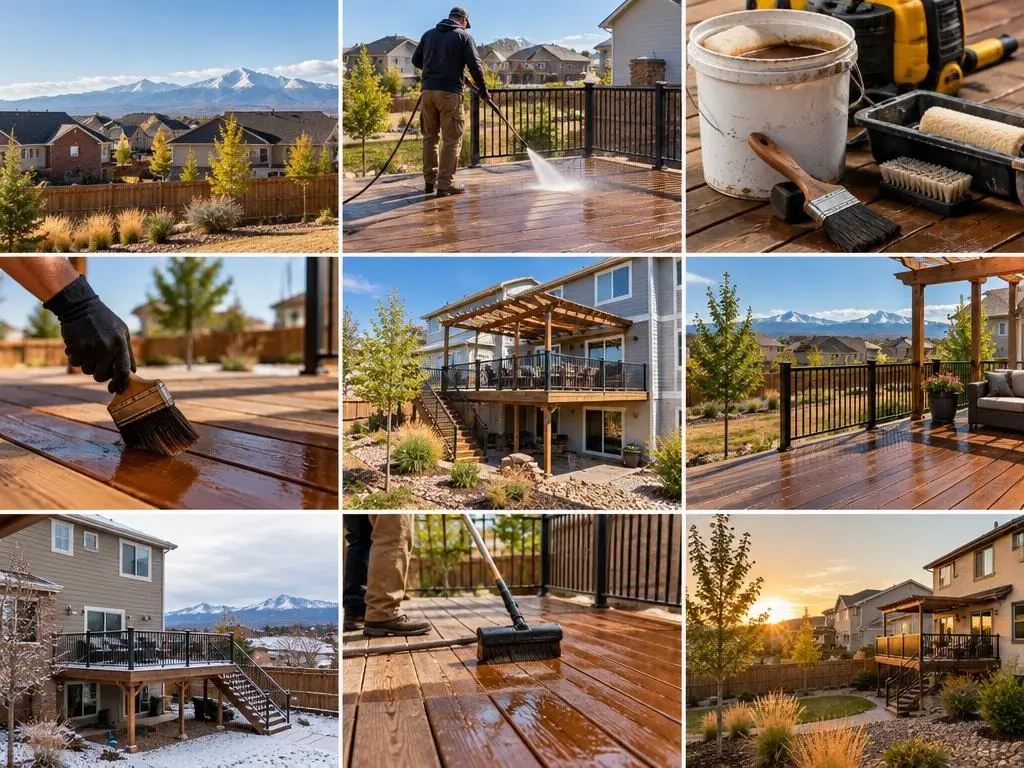
- Staining and sealing for wood decks in the dry, sunny climate
Call (720) 604-3036 or
to set up a free visit.Denver Conditions for Deck Building
- Big daily temperature swings. Denver's average daily temperature range runs between about 26.7 and 30.5°F, daytime humidity stays very low, and the city averages around 270 clear or partly cloudy days a year, so deck boards expand and contract daily.
- Three record-cost hailstorms. Denver has been ranked 10th most hail-prone among U.S. cities of at least 50,000 people and was hit by three of the ten costliest U.S. hailstorms: July 11, 1990; July 20, 2009; and May 8, 2017.
- Snow season and last freeze. Measurable snow usually falls from about October 17 through April 27, March is the second-snowiest month at around 10.7 inches, and the average last spring freeze is about May 6.
- Less than half owner-occupied. About 48.8% of Denver homes are owner-occupied and the average household has 2.10 people (Census ACS 2020-2024), so many decks belong to rental properties.
- Consolidated city-county. Denver became a consolidated city and county on December 1, 1902, and has 78 official neighborhoods; its official elevation of 5,280 feet is defined by a benchmark on the State Capitol steps.
Denver Questions
Why do composite boards buckle or gap on some Denver decks?
Usually because they were not gapped for temperature. Composite expands in heat and shrinks in cold, and Denver can swing close to 30 degrees in a single day. We follow the manufacturer's spacing for the install-day temperature and leave room at butt joints and ends.
Hail damaged my deck cover. Can you repair just that part?
Yes. We can replace cracked or dented cover panels, damaged boards or railing sections without rebuilding the whole deck. We document what we find and provide a written scope you can share with your insurance company.
I own a Denver rental. What deck materials hold up best?
Capped composite or PVC decking with aluminum or composite railings needs the least upkeep between tenants. If budget calls for wood, a solid stain on treated lumber is a reasonable middle ground, but plan on refinishing it every few years.
Do Denver deck permits work the same as Aurora's?
No. Denver handles its own permits and zoning as a combined city and county, and its rules differ from Aurora's. We check Denver's requirements for your lot before drawing plans.
Free Estimates in Denver, CO
Free deck estimates across Denver's neighborhoods.
Deck Builders Near Denver
- Deck Builders in Aurora, CO
- Deck Builders in Centennial, CO
- Deck Builders in Parker, CO
- Deck Builders in Englewood, CO
- Deck Builders in Greenwood Village, CO
- Deck Builders in Littleton, CO
- Deck Builders in Highlands Ranch, CO
- Deck Builders in Lone Tree, CO
- Deck Builders in Castle Rock, CO
- Deck Builders in Commerce City, CO
- Deck Builders in Brighton, CO
- Deck Builders in Thornton, CO
- Deck Builders in Northglenn, CO
- Deck Builders in Westminster, CO
- Deck Builders in Arvada, CO
- Deck Builders in Lakewood, CO
- Deck Builders in Elizabeth, CO